Independent concept in validation — no payment or pre-order
MT150 Thermal processing for 3D printing
Precision drying.
Controlled annealing.
One purpose-built chamber for actively drying filament and running repeatable thermal cycles on large 3D-printed parts.
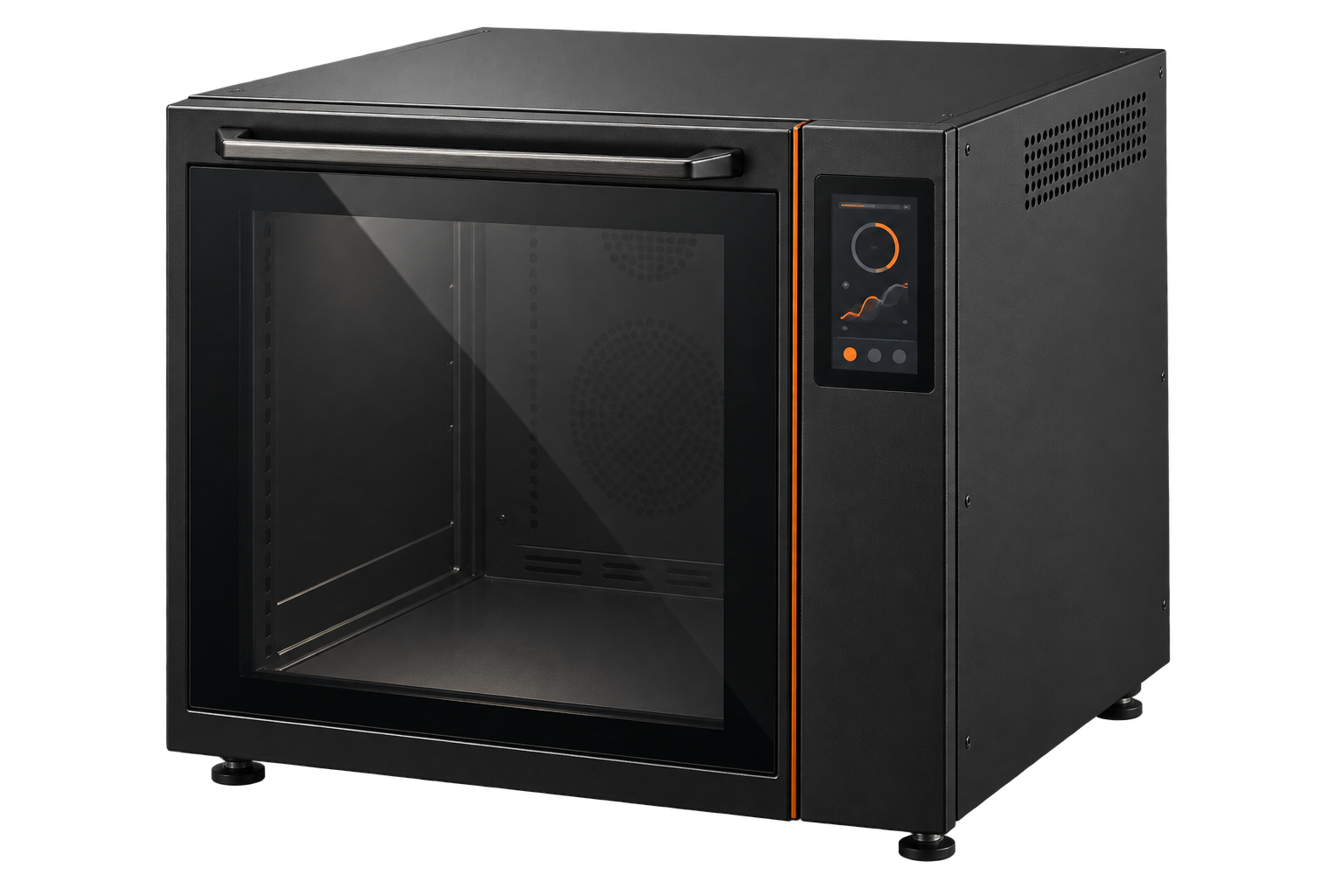 CONCEPT RENDER · DESIGN NOT FINAL
PART PROBE99.8 °CReady to hold
01 / THE GAP
Your printer evolved.
Post-processing didn’t.
Modern prosumer machines print large functional parts in PETG, ASA, ABS, PA, PC and fibre-filled polymers. Yet the next step is often improvised: a small dryer for spools, a kitchen oven for parts or a laboratory oven priced for industry.
MakerTherm MT150 targets the space between them: workshop-sized, process-focused and designed around the parts today’s 350 mm-class printers can produce.
Remove moisture before it reaches the nozzle.
Stable heat, circulated air and managed exhaust for everyday and engineering filaments — without pretending that every spool needs the same cycle.
- 01Select the material profile
- 02Dry at the specified temperature
- 03Transfer to sealed storage or print
Control the complete thermal cycle.
Programmable ramp, part-aware hold and controlled cool-down for formulations with a documented annealing or stress-relief process.
- 01Attach the removable part probe
- 02Ramp until the part reaches target
- 03Hold, then cool in a controlled way
02 / PART-AWARE CONTROL
The air can be ready while the part is not.
Thicker prints heat more slowly than the surrounding chamber. A normal timer cannot see that difference. The proposed removable contact probe follows the part itself, so the hold phase can begin at the correct moment.
“Start timing the process when the part reaches target — not when the air does.”
03 / WHY 150 °C
A wide working range.
No vague promises.
Exact temperature and duration always come from the filament manufacturer. These bands explain the intended capability, not universal presets.
40°60°80°100°120°150°
Everyday drying
Engineering drying
High-temp drying
Annealing
PLA, PETG, TPU, ABS, ASA, PA, PC, PP, PVA/BVOH, PET and many filled formulations are within the intended range.
HT-PLA and selected PLA, PET, PA or PC formulations can use validated profiles. Dimensional change must always be expected and tested.
Cycles above 150 °C and universal annealing claims for PEEK, PEKK or PEI parts are intentionally outside the MT150 scope.
Reference examples: Prusa drying guidance, Bambu Lab drying guidance and Polymaker annealing guidance.
04 / TARGET ARCHITECTURE
Designed around the process, not adapted from an oven.
These are engineering targets for the prototype and will be confirmed through thermal mapping, safety testing and certification work.
Dual temperature awareness
A chamber sensor controls the air while a removable contact probe follows the actual printed part.
Programmable thermal profiles
Set controlled ramp, soak and cool-down phases instead of relying on a single temperature and timer.
Forced, distributed airflow
The target architecture circulates heat around large parts and multiple spools to reduce hot and cold zones.
Managed moisture exhaust
Drying needs somewhere for released moisture to go. The proposed exhaust is adjustable by process.
Large removable interior
A 350 mm-class useful chamber with removable shelves is sized around current prosumer build volumes.
Local, profile-based control
Core cycles remain available on the device. Custom profiles can be saved without depending on a cloud service.
05 / THE POSITION
Not another spool box.
Not a laboratory oven.
A workshop tool aimed at the gap between basic dryers and equipment that costs far more than the printer beside it.
| Approach | Drying control | Useful part volume | Part probe | Price position |
|---|---|---|---|---|
| Filament dryer | Good | Limited | No | Low–mid |
| Kitchen oven | Uncontrolled | Good | No | Already owned |
| Laboratory oven | Excellent | Good | Usually no | Very high |
| MakerTherm MT150 target | Controlled | 350 mm class | Yes | €449–499 |
06 / SAFETY TARGETS
Heat needs more than software.
The prototype brief includes layered protection so a controller fault is not the only thing standing between normal operation and overheating.
- 01Independent over-temperature cutoff
- 02Door-state monitoring and safe pause
- 03Insulated enclosure and controlled exterior temperatures
- 04Fan and sensor fault detection
- 05Non-combustible internal construction targets
- 06EU electrical safety and EMC validation before sale
Safety architecture shown here is a design requirement, not a certification claim. Final specifications depend on prototype testing and conformity assessment.
07 / CLEAR ANSWERS
Before you say
“I’m interested.”
No invented release date, no fake discount and no deposit. Just the information needed to judge the concept honestly.
Is 150 °C enough?+
For the intended scope, it covers common filament drying temperatures and reaches demanding cases such as PEI drying at up to 150 °C. It also covers many manufacturer-defined annealing cycles for printable polymers. It is not intended for every high-performance polymer process, and it does not replace equipment above 150 °C.
Can every material be annealed?+
No. Annealing is formulation-specific. Some HT-PLA, PLA composites and selected PA, PET or PC formulations have validated cycles; other materials may soften, shrink or distort. MakerTherm profiles would follow the filament manufacturer’s instructions, with custom profiles for documented cases.
Why measure the part instead of only the chamber?+
A thick printed component can lag behind the surrounding air. The removable contact probe is intended to let the hold phase begin only after the part reaches its target temperature, improving repeatability between different geometries.
Does it replace dry storage?+
No. MT150 is being designed to actively remove moisture. Long-term storage is a different job: after drying, filament should move to a sealed dry box, vacuum bag or compatible storage system.
Can it be used for food?+
No. It is a dedicated workshop appliance for 3D-printing materials and parts. It should never be used for food preparation or share the same chamber with food.
When can I buy it?+
Not yet. This page validates demand before the full-size thermal prototype is funded. The target price is €449–499, but final specifications, certification and price depend on engineering validation.
08 / VALIDATE THE PRODUCT
€449 to €499Would this earn a place in your workshop?
We will use these responses to decide whether to spend the first €1,000 on a full-size thermal prototype. Tell us what you print and what would make the MT150 worth buying.
✓ No payment✓ No purchase commitment✓ One response per email